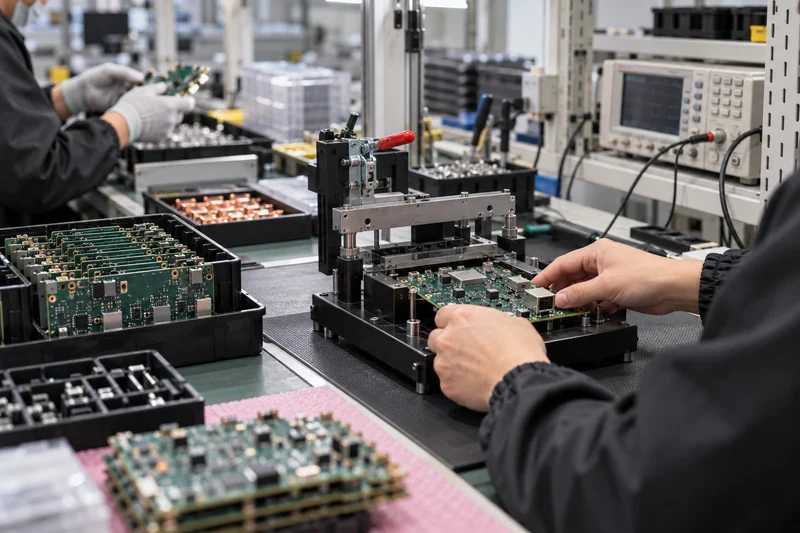
A working prototype shows that an idea can function. A pilot build asks a different question: can the team assemble, program, test and document the same product repeatedly? Before placing the pilot order, make the configuration and the unresolved decisions visible.
REVIEW CHECKPOINTS
- Freeze a reviewable configuration
- Review the risks that affect assembly and test
- Confirm parts and substitutions before purchase
- Define the pilot exit decision
Freeze a reviewable configuration
Collect the released schematic, PCB fabrication and assembly files, mechanical drawings, firmware image, BOM and test instructions in one revision-controlled package. Name the owner and version of each file. If the firmware or enclosure has changed since the last prototype, record that difference rather than treating the prototype result as proof for the new configuration.
The team should be able to answer a simple question: which exact files will the supplier use for this pilot? If two plausible answers exist, the build is not ready to release.
- Board revision and fabrication outputs
- BOM revision with approved manufacturer part numbers
- Firmware build identifier and programming instructions
- Assembly drawing, enclosure revision and test plan
Review the risks that affect assembly and test
Walk through component orientation, connector access, mechanical clearances, programming points and expected rework. Check whether the proposed test fixture and procedure can distinguish a good unit from a known failure. A test that only proves the device powers on may leave important communication, sensing or safety behavior unverified.
Separate issues that block the pilot from issues that can be observed during it. Give every open issue an owner, a next action and a decision date. This keeps the pilot useful as a learning build without silently accepting avoidable risk.
Confirm parts and substitutions before purchase
Check availability, lifecycle status and lead times for critical parts. For a proposed substitute, compare the electrical, firmware, mechanical and test implications. A matching package or headline specification is not enough to establish interchangeability. Record who can approve the change and what evidence they need.
- Which parts have only one viable source?
- Which alternates have been technically reviewed?
- What incoming checks are needed for high-risk components?
Define the pilot exit decision
Agree what the pilot should produce: unit-level test results, defect and rework records, assembly observations, yield calculation method and a list of unresolved issues. Decide in advance who will accept the findings and authorize the next revision or order. The value of a pilot lies in the decisions it enables, not only the number of units assembled.
If the team needs help reviewing these gates, see the Hardware Build Process and Hardware Build Records pages. A first conversation can start with the current file set and the decision holding up the build.
General engineering guidance. Validation and acceptance criteria depend on your product and intended use.