
Introduction: The Silent Intelligence of Hardware
In the world of industrial automation and consumer electronics, the microcontroller (MCU) is the brain, but the firmware is its soul. A common pitfall in modern hardware development is over-specifying the processor to compensate for inefficient code. However, true engineering excellence lies in extracting maximum performance from every clock cycle.
With over two decades of experience in MCU development and automation systems, I have seen how a poorly structured firmware architecture can lead to jitter, missed interrupts, and system instability. This article delves into the advanced techniques of firmware optimization—focusing on interrupt management, power efficiency, and real-time task scheduling—to build robust systems that stand the test of industrial-grade reliability.
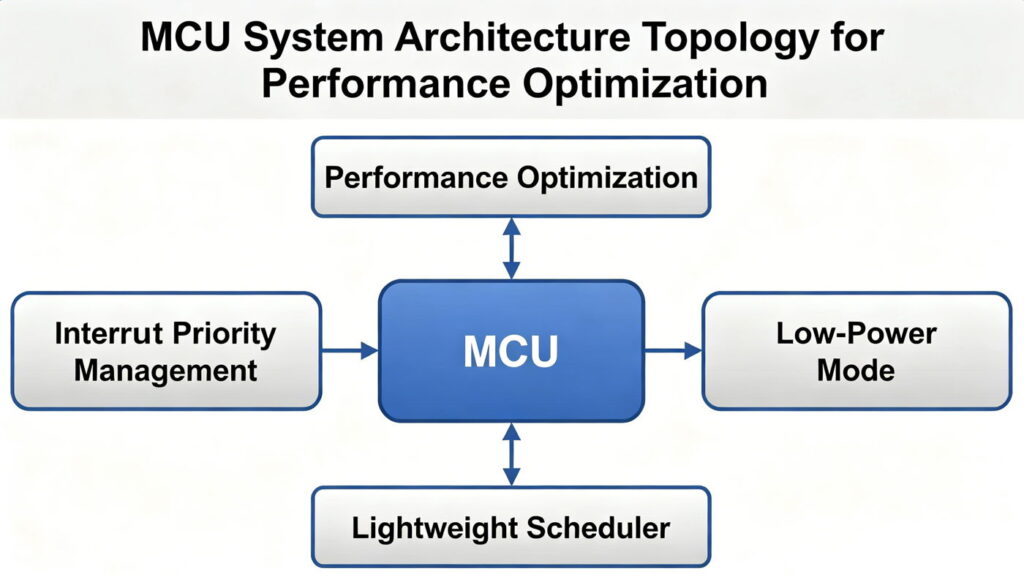
1. Precision in Execution: Advanced Interrupt Priority Management
The hallmark of a professional embedded system is its ability to handle asynchronous events with predictable latency. In complex industrial control—such as high-speed motor driving or precision temperature regulation—interrupt management is the first line of defense against system failure.
The Hierarchy of Determinism
Effective firmware design utilizes a multi-level nested vectored interrupt controller (NVIC). We don’t just “enable” interrupts; we architect them.
- Time-Critical Tasks: High-priority interrupts are reserved for safety-critical feedback loops and high-speed communication (e.g., CAN bus or SPI high-speed acquisition).
- Preventing Priority Inversion: We implement strict protocols to ensure that low-priority tasks never inadvertently block high-priority execution, a common cause of “mysterious” system resets in ODM products.
- Jitter Reduction: By minimizing ISR (Interrupt Service Routine) execution time and offloading heavy processing to the main loop or DMA (Direct Memory Access), we ensure that the system remains responsive even under peak processing loads.
2. Beyond Code: Power Optimization and Low-Power States
In the era of Industrial IoT and battery-powered edge devices, power efficiency is as critical as processing speed. Optimizing an MCU’s power consumption requires a deep understanding of the silicon’s clock tree and power domains.
Strategic Power Management
At TENGDA, our firmware architecture is designed to be “power-aware.”
- Dynamic Clock Scaling: We adjust the MCU’s core frequency based on the immediate workload, reducing the dynamic current draw during idle periods.
- Sleep Mode Orchestration: Utilizing modes like “Stop,” “Standby,” or “Low-Power Run” isn’t just about turning off the CPU. We carefully manage the wake-up latency to ensure that the device transitions back to full operation within microseconds when a sensor trigger occurs.
- Peripheral Gating: Disabling unused peripherals (UART, ADC, Timers) at the register level ensures that every milliampere is utilized for productive work, extending the lifespan of remote sensors significantly.
3. Development Practice: Building Lightweight Schedulers for Multitasking
When a project doesn’t require the overhead of a full RTOS (Real-Time Operating System), the challenge is to manage concurrency without sacrificing simplicity. This is where a custom, lightweight cooperative or preemptive scheduler becomes invaluable.
The “Bare-Metal” Masterpiece
For many of our OEM/ODM projects, we deploy a proprietary State-Machine Driven Scheduler.
- Non-Blocking Logic: We replace all “delay()” functions with non-blocking timers. This allows the MCU to monitor temperature, update a display, and process serial commands simultaneously without any single task “freezing” the CPU.
- Deterministic Scheduling: By utilizing a “Round-Robin” or “Priority-Based” loop, we ensure that every critical task is serviced within a fixed time window. This level of predictability is what separates industrial controllers from hobbyist boards.
4. The 20-Year Insight: Ensuring Firmware Robustness in OEM/ODM
Transitioning a prototype to a mass-produced product requires more than just functional code; it requires Rugged Firmware. Based on our 20-year history in the Shenzhen electronics hub, we apply several critical “Rules of Robustness”:
- Watchdog Engineering: We don’t just use the Watchdog Timer (WDT) as a safety net; we integrate it into the task scheduler to ensure that if any specific thread hangs, the system can gracefully recover.
- Memory Integrity: In high-interference industrial environments, bit-flips can happen. We implement CRC checks for critical configuration data and “defensive programming” to handle unexpected state transitions.
- Scalable Bootloaders: Every professional product needs a secure path for field updates. Our custom bootloaders support encrypted OTA (Over-The-Air) or wired updates, ensuring long-term maintainability for our European and American clients.
Conclusion: Engineering the Future, One Instruction at a Time
Efficient firmware is the bridge between a vision and a functional, reliable product. Whether it’s a high-precision sensor module or a complex industrial gateway, the architecture of the embedded system determines its ultimate success.
At TENGDA ENGINEERING , we combine a deep understanding of MCU silicon with two decades of practical automation experience. We don’t just write code; we engineer the logic that drives the modern world.
Looking for an optimized firmware solution for your next product? Consult with our lead engineer at [email protected] to explore how we can elevate your hardware performance through superior architectural design.