
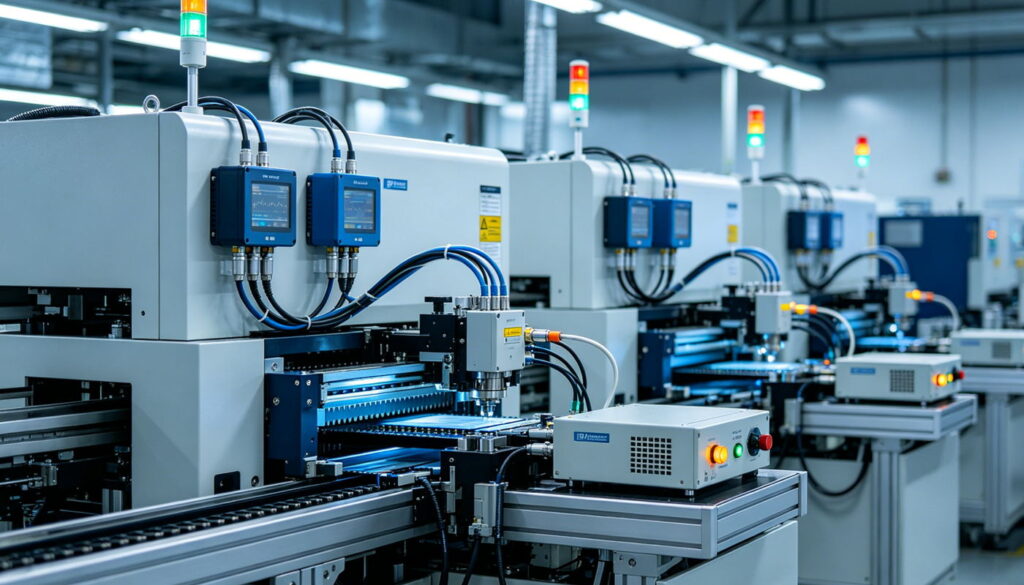
Introduction: From Reactive to Proactive Excellence
In the demanding landscape of modern electronics manufacturing and heavy industry, the cost of equipment failure is measured not just in repair bills, but in catastrophic downtime and lost opportunity. Traditional maintenance models—either “run-to-failure” (reactive) or “fixed-interval” (preventative)—are increasingly insufficient for today’s high-precision environments.
As an automation firm with over two decades of experience in MCU development and system integration, we are witnessing a paradigm shift. The integration of Smart Sensors and Industrial IoT (IIoT) has enabled a new standard: Predictive Maintenance (PdM). By analyzing real-time data to anticipate failures before they occur, factories can achieve near-zero unplanned downtime. This article explores the technical architecture and real-world implementation of PdM systems that are redefining industrial efficiency.
1. The Core Trend: Why Predictive Maintenance is the New Gold Standard
The evolution of sensors from simple analog transducers to intelligent, network-aware nodes has changed the nature of industrial diagnostics. Predictive maintenance goes beyond simple threshold alerts; it utilizes continuous vibration analysis, thermal profiling, and acoustic monitoring to identify the “P-F Interval”—the time between the potential failure and the actual functional failure.
The Economic Impact of Real-Time Monitoring
For an SMT (Surface Mount Technology) production line or a high-speed PCB assembly plant, even a ten-minute stoppage can ripple through the entire supply chain. Our research into PdM sensors indicates that implementing real-time monitoring can reduce maintenance costs by up to 30% and decrease downtime by nearly 50%. The ability to detect a worn bearing in a robotic arm or a degrading heating element in a reflow oven—weeks before they fail—allows for scheduled maintenance during natural production gaps, ensuring that the assembly line never stops unexpectedly.
2. Technical Architecture: The End-to-End IIoT Chain
A robust Predictive Maintenance system is a multi-layered masterpiece of engineering. At TENGDA, we specialize in the entire data lifecycle, ensuring that raw physical signals are transformed into actionable business intelligence.
Layer 1: The Sensor Fabric (Data Acquisition)
The journey begins at the edge. We deploy high-sensitivity MEMS accelerometers for vibration monitoring, NTC/PT1000 RTDs for thermal sensing, and Hall-effect sensors for current analysis. These sensors are integrated into custom-designed MCU modules capable of high-frequency sampling. In precision electronics manufacturing, capturing high-fidelity data is critical; aliasing or noise at this stage renders the entire AI analysis moot.
Layer 2: Edge Computing and Gateway Processing
Sending raw, high-frequency data directly to the cloud is bandwidth-intensive and introduces latency. Our architecture utilizes Edge Computing Gateways. These units perform localized FFT (Fast Fourier Transform) and anomaly detection. By processing data locally on an ARM-based Linux gateway, the system only transmits “feature vectors”—significant changes in the machine’s signature—to the central server. This ensures real-time responsiveness and data efficiency.
Layer 3: Cloud Integration and Predictive Analytics
Once data reaches the cloud (via MQTT or OPC-UA protocols), it is fed into digital twin models. By comparing current machine behavior against a historical “golden baseline,” our algorithms can predict the remaining useful life (RUL) of critical components. This is where hardware meets software: the deep integration of firmware-level data collection and cloud-level big data analysis.
3. Industry Application: Precision Temperature Control in Complex Environments
The theory of IIoT is best proven through rigorous application. One of our hallmark solutions involves High-Precision Temperature Control Modules in demanding industrial environments.
The Challenge of Thermal Stability
In sectors like semiconductor testing or precision chemical processing, a variance of even 0.1°C can compromise product integrity. Standard PID controllers often struggle with the “thermal inertia” of complex systems, leading to overshooting or sluggish response times.
The TENGDA Solution
We developed an IoT-enabled temperature control system that utilizes predictive logic. Instead of merely reacting to a temperature drop, the smart sensors monitor ambient variables, power fluctuations, and fluid flow rates.
- Performance: Our modules maintain stability within ±0.05°C under varying load conditions.
- Predictive Diagnostics: The system monitors the “Health Index” of the heating elements and cooling fans. If a fan’s RPM fluctuates or a heater’s resistance changes beyond a calculated tolerance, an alert is sent to the dashboard, allowing for a replacement before the thermal process fails.
4. Engineering Philosophy: Building for the “One-Person” Enterprise
We understand that many modern tech firms and specialized workshops operate as lean, high-efficiency units—what we call the “One-Person Company” model. A complex IIoT system should not require a massive IT department to maintain.
Our design philosophy centers on Low-Friction Operation:
- Plug-and-Play Integration: Sensors and gateways are designed for rapid deployment without complex rewiring.
- Autonomous Alerts: The system manages itself, only interrupting the operator when an intervention is truly necessary.
- Scalable Security: Utilizing the same rigorous standards we applied to our DKIM and SPF email security protocols, our IIoT data is encrypted from the sensor to the cloud, ensuring that your industrial “DNA” is never compromised.
Conclusion: Partnering for a Smarter Future
The transition to the “Smart Factory” is not a destination, but a continuous journey of optimization. Predictive Maintenance is the bridge between traditional mechanical engineering and the future of digital intelligence.
At TENGDA ENGINEERING , we combine 20 years of automation expertise with cutting-edge IIoT research to provide solutions that are not just theoretically sound, but industrially proven. Whether you are looking to optimize a single production line or deploy a global network of smart sensors, we have the technical depth to lead the way.
Ready to eliminate unplanned downtime? Contact our lead engineer directly at [email protected] to discuss your project requirements or to request a technical audit of your current automation infrastructure.