
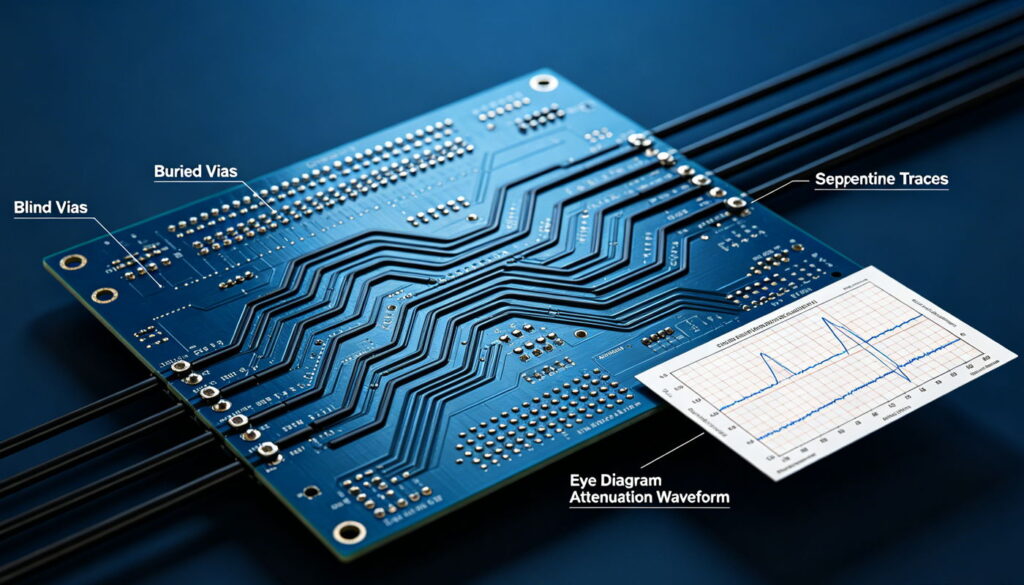
Introduction: The Digital Backbone of Industrial Automation
In the era of Industrial IoT and precision automation, the reliability of a hardware product isn’t just decided by its code, but by the physical integrity of its signals. As we transition from simple controllers to complex MCU-based edge intelligence, the margin for error in PCB design has effectively vanished. This article leverages two decades of engineering experience to dissect the critical elements of high-speed digital design.
Section 1: The Physics of Signal Integrity (SI)
Signal integrity is no longer a luxury—it is a functional requirement. When a clock signal reaches the GHz range, every millimeter of a copper trace acts as a transmission line.
- Controlled Impedance: We must calculate the trace width and spacing relative to the dielectric constant of the FR-4 or high-frequency substrate to maintain a consistent 50Ω or 100Ω differential impedance.
- Crosstalk Mitigation: By implementing the “3W rule” and ensuring proper guard traces, we minimize the inductive and capacitive coupling between adjacent high-speed lanes.
Section 2: Advanced Multi-Layer Stackup Strategies
The foundation of a stable PCB is its stackup. For our OEM/ODM clients, we prioritize a “Ground-Centric” philosophy.
- Reference Planes: Every signal layer must be adjacent to a solid ground plane to provide a low-impedance return path, significantly reducing the loop area and EMI radiation.
- Power Decoupling: Placing decoupling capacitors in a grid formation as close as possible to the MCU power pins is essential for stabilizing the PDN (Power Delivery Network) during high-speed switching.
Section 3: Bridging Hardware and Firmware
As a specialist in MCU development, I understand that stable hardware is the prerequisite for robust firmware. Whether it’s designing precision temperature control modules or IoT communication interfaces, the physical layout must account for thermal dissipation and analog-digital isolation to prevent noise injection into sensitive ADC circuits.
Conclusion: Engineering Excellence at TENGDA
At TENGDA ENGINEERING , we don’t just design boards; we engineer solutions that survive the rigors of industrial environments. Our commitment to technical rigor ensures that your hardware vision is built on a foundation of absolute stability.